
Stop Memorizing APIs: Why Technical Execution is Becoming Worthless in 2026
The brutal truth about what actually matters when 82% of developers use AI coding tools
Two developers sit in the same interview room. Both have five years of experience. Both can implement a REST API in their sleep. Both know React hooks, database normalization, and the difference between OAuth and JWT.
The interviewer asks: “Design a system for handling 10 million daily transactions with strict audit requirements and eventual consistency constraints.”
Developer A opens their laptop and starts typing furiously, prompting Claude or ChatGPT to generate the boilerplate. They produce working code in minutes.
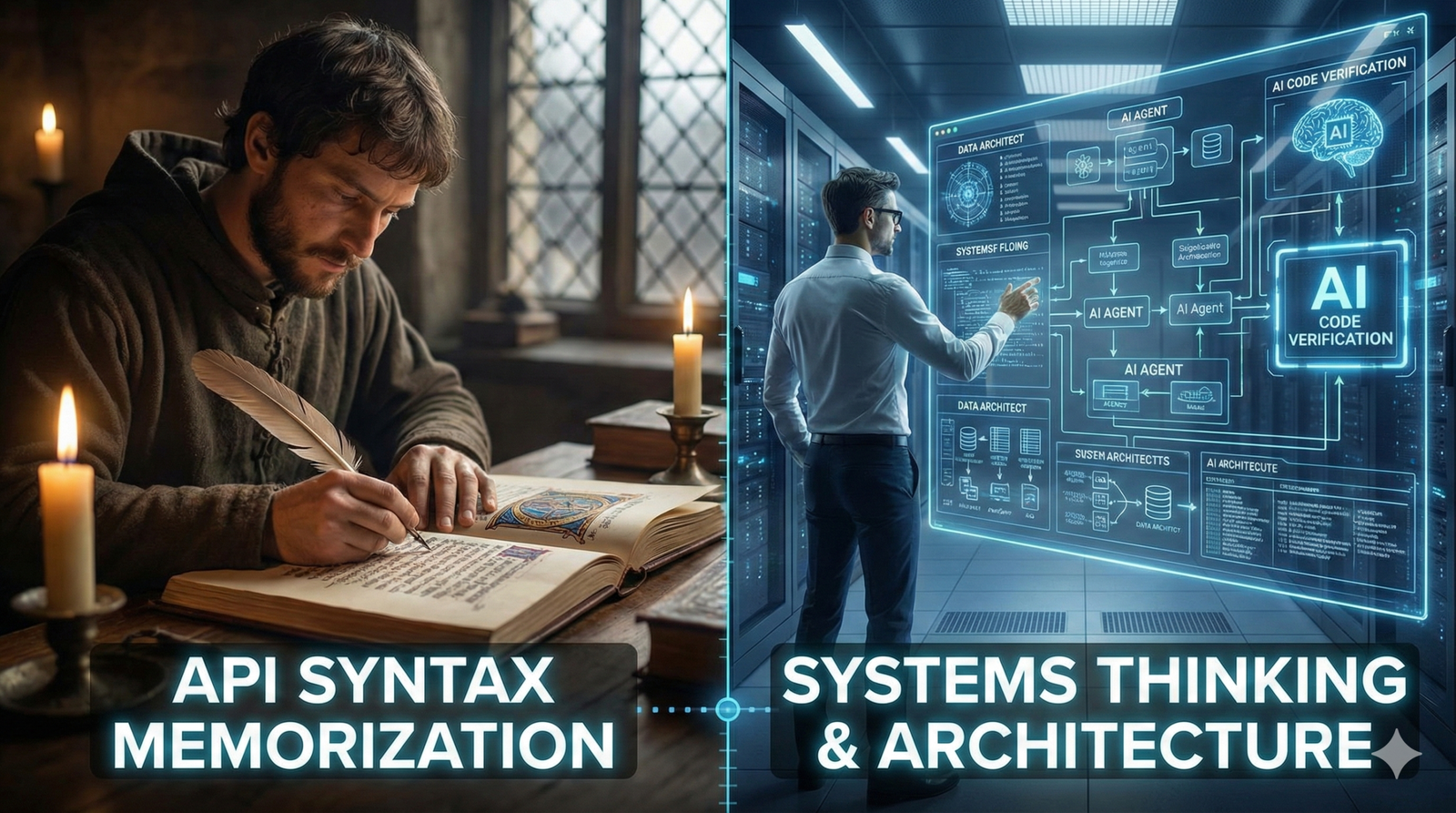
Developer B pauses. They sketch out the architecture on a whiteboard: event sourcing for audit trails, CQRS for read/write separation, idempotency keys for transaction safety. They discuss CAP theorem trade-offs, explain why eventual consistency matters for regulatory compliance, and outline the failure modes they’d need to handle. No code yet—just clear thinking about system design.
Developer B gets the job. Developer A gets a polite rejection email.
This isn’t a hypothetical. This is happening right now, in 2026, across every tech company that’s paying attention. The game has fundamentally changed, and most developers haven’t noticed yet.
The Data Is Undeniable: AI Has Reached Critical Mass
Let’s start with the numbers that should terrify anyone whose primary skill is “knowing how to implement things.”
In 2025, 82-84% of developers now use AI coding tools. Not “trying them out”—actively using them in their daily work. The AI code generation market exploded from $4.91 billion in 2024 to a projected $30.1 billion by 2032. Coding represents $4.0 billion—55% of all enterprise AI spend—making it the single largest category in the AI application layer.
Sources: Stack Overflow Developer Survey 2025, Menlo Ventures AI Application Layer Report
Here’s what that actually means: 41% of all code being written today is AI-generated or AI-assisted. Nearly half. Think about that for a moment.
The Productivity Paradox
But here’s where it gets interesting—and uncomfortable. While developers complete 21% more tasks with AI assistance, something unexpected happened: pull request review time increased by 91%.
Read that again. Reviews take twice as long despite code being produced faster. Why? Because AI-generated code often looks correct but contains subtle bugs, architectural missteps, or security vulnerabilities that require deep expertise to catch.
Only 30% of AI-suggested code gets accepted by developers. The other 70%? It’s close enough to look reasonable but wrong enough to cause production issues if shipped unchecked.
Source: GitClear Analysis
The Trust Crisis Nobody’s Talking About
Even as adoption skyrockets, trust is plummeting. In 2025, 46% of developers don’t trust AI accuracy—up sharply from 31% the previous year. Two-thirds (66%) report that AI solutions are “close but ultimately miss the mark.” And here’s the kicker: 45% say debugging AI-generated code takes longer than writing it themselves from scratch.
So everyone is using AI tools, but half of them don’t trust what those tools produce. This isn’t sustainable. What it signals is a massive filtering process happening right now in the industry: developers who can spot when AI is wrong and fix it are thriving. Those who blindly accept AI output are creating technical debt at an unprecedented scale.
Source: Stack Overflow Developer Survey 2025
The Silent Purge: What’s Actually Happening to Junior Developers
Now let’s talk about the part that makes everyone uncomfortable: the hiring data.
A Harvard study found that when companies adopt generative AI tools, junior developer employment drops by about 9-10% within six quarters. Senior employment? Barely moves. Big tech companies hired 50% fewer fresh graduates over the past three years.
A Stanford analysis found that employment among software developers aged 22 to 25 fell nearly 20% between 2022 and 2025.
Sources: Harvard Business School Research, Stanford Digital Economy Lab
This isn’t a temporary downturn. This is a fundamental recalibration of what companies need. The traditional junior developer role—learning on the job while handling relatively straightforward implementation tasks—is being automated away.
What Companies Actually Say They Need Now
Hiring managers across the industry are recalibrating what they look for. The shift is stark: expertise in AI augmentation, system architecture, and cross-functional problem-solving has become paramount. Software architecture, system design, performance tuning, and security analysis top the list of critical skills.
One CTO crystallized the shift perfectly:
“I can give any competent developer AI tools and they’ll write the code. What I cannot easily find is someone who knows why we should use event sourcing for our transaction ledger instead of a simple CRUD model, and who can articulate the implications of that choice for our audit requirements and regulatory compliance.”
AI can rapidly produce a functional web application. But it takes an expert engineer to ensure that application follows security best practices, doesn’t introduce race conditions, handles edge cases gracefully, and scales appropriately.
How Interviews Have Changed
Companies have shifted their interview criteria dramatically. The focus has moved from coding speed and algorithm implementation to system design, failure mode analysis, and the ability to articulate trade-offs between different technical approaches.
Leetcode grinding? Still useful for getting past automated screens, but it’s no longer the deciding factor. Companies want to know:
- Can you design a system that handles real-world constraints?
- Can you identify when AI-generated code will cause problems in production?
- Can you explain complex technical trade-offs to non-technical stakeholders?
- Do you understand the ‘why’ behind architectural patterns, not just the ‘how’?
Why This Happened Faster Than Anyone Expected
Three years ago, when GitHub Copilot launched, most developers viewed it as a curiosity—a fancy autocomplete. The consensus was that AI might handle boilerplate eventually, but real engineering would always require human expertise.
That consensus was wrong. Not about AI replacing engineers entirely, but about how quickly it would reach the “good enough” threshold for routine implementation work.
The ‘Good Enough’ Threshold
AI coding tools didn’t need to become perfect. They just needed to become good enough that a senior developer using AI could do the work of their former team of five.
That threshold was crossed somewhere in late 2024. Claude 3.5 Sonnet, GPT-4, and other models reached a capability level where they could:
- Implement standard CRUD operations correctly most of the time
- Write reasonably clean, documented code
- Handle common edge cases when prompted
- Translate requirements into working code faster than typing
The keyword is “most of the time.” AI tools are unreliable, yes. But so are junior developers. The difference is that AI tools are getting better exponentially, while junior developer growth follows a linear learning curve.
The Compound Effect
Here’s the brutal economic reality that drove the adoption curve:
A senior developer with AI tools can now:
- Prototype new features in hours instead of days
- Maintain multiple codebases simultaneously
- Handle both backend and frontend work competently
- Debug and fix issues across the stack
Companies did the math: one senior developer at $200k + AI tools at $20/month versus three junior developers at $120k each. The ROI was obvious.
Economic Pressures Accelerating Adoption
The 2023-2024 tech downturn created perfect conditions for this shift. Companies needed to cut costs while maintaining output. AI coding tools offered exactly that: force multiplication for experienced engineers at minimal cost.
The adoption pattern was predictable: startups moved first (they had to), followed by tech companies under margin pressure, and now enterprise is catching up. Once a few companies demonstrated that smaller teams with AI tools could outperform larger teams without them, the shift became irreversible.
The New Skill Hierarchy: What Actually Matters in 2026
If implementation is commoditized, what becomes valuable? The answer is more nuanced than “just learn system design.”
1. System Design and Architecture Judgment
This isn’t about memorizing CAP theorem or drawing microservices diagrams in interviews. It’s about developing intuition for when different approaches make sense.
Real architecture judgment means understanding:
- Trade-offs between consistency and availability for your specific use case
- When to use event sourcing versus traditional state storage
- Why your caching strategy matters more than your database choice
- The hidden costs of distributed systems before you commit to them
AI can generate a microservices architecture. But it won’t tell you that your startup with 1,000 users doesn’t need one and that the operational complexity will sink your team.
2. Problem Decomposition and Requirement Gathering
AI is brilliant at solving well-defined problems. It’s terrible at figuring out what the actual problem is.
The most valuable developers in 2026 are those who can:
- Talk to product managers and extract the real requirements beneath the stated ones
- Identify edge cases and failure modes before writing any code
- Break down ambiguous business problems into clear technical specifications
- Ask the right questions before committing to an implementation approach
This skill compounds with AI assistance. The better you are at decomposing problems, the better prompts you write, and the more useful AI output becomes.
3. Understanding ‘Why’ Over ‘How’
Memorizing syntax is worthless. Memorizing framework APIs is worthless. Even memorizing algorithms is becoming less valuable.
What’s valuable is understanding why things work the way they do:
- Why does React use a virtual DOM? (Not how to use useState)
- Why do databases use B-trees for indexes? (Not how to write a CREATE INDEX statement)
- Why does eventual consistency matter for distributed systems? (Not how to configure Kafka)
When you understand the ‘why,’ you can evaluate AI-generated code critically. When you only know the ‘how,’ you’re just hoping the AI got it right.
4. Cross-Functional Communication
The stereotype of the developer who just wants to be left alone to code? That person is becoming unemployable.
When implementation becomes commoditized, the value shifts to those who can:
- Translate technical constraints into business impact
- Explain complex trade-offs to non-technical stakeholders
- Work effectively with product, design, and business teams
- Advocate for technical quality without being dogmatic
AI can write code. It cannot sit in a meeting and negotiate technical debt priorities with a VP who wants to ship features faster.
5. Product Thinking and User Empathy
The best developers in 2026 aren’t just engineers—they’re engineers who think like product managers.
They understand:
- Why users behave the way they do
- How technical decisions affect user experience
- When to push back on product requirements and when to just ship
- How to balance technical perfection with business velocity
This is the hardest skill to automate because it requires real-world context, empathy, and judgment that can’t be reduced to training data.
What This Means for Different Developer Personas
Junior Developers: The Brutal Truth
If you’re early in your career, this is the hardest truth: the traditional junior developer role is disappearing. The path of “learn by doing straightforward implementation tasks while seniors handle the hard stuff” no longer exists at many companies.
But this doesn’t mean the path is closed—it means you need a different strategy:
- Build fundamentals ruthlessly. Understand how computers actually work, how networks function, how databases store data. You need this foundation to evaluate AI output.
- Focus on problems, not solutions. Instead of learning specific frameworks, learn how to decompose problems and design solutions.
- Develop taste through code review. Study how senior developers critique AI-generated code. Learn to spot the subtle issues.
- Get good at AI prompting. This sounds trivial but isn’t. The ability to get high-quality output from AI tools is itself a learnable skill.
- Build things end-to-end. Don’t just implement tickets. Build complete projects where you handle requirements, design, implementation, and deployment.
The good news? If you develop these skills, you’ll be more valuable than junior developers from five years ago because you’ll have force multiplication from AI tools.
Mid-Level Developers: The Pivot Point
If you’re at the mid-level, you’re at a critical juncture. You’re experienced enough to deliver value but not senior enough to be immune to automation pressure.
Your move:
- Shift from implementer to architect. Start taking on system design work. Volunteer for architectural decisions.
- Become the AI-quality gatekeeper. Be the person who reviews AI-generated code and catches issues. Build a reputation for this.
- Learn to work with non-technical stakeholders. Get involved in product discussions. Understand the business.
- Specialize in hard problems. Find the areas where AI tools struggle—complex distributed systems, performance optimization, security. Go deep there.
The mid-level developers who thrive are those who actively choose to level up to senior responsibilities rather than waiting to be promoted.
Senior Developers: Why You’re Actually More Valuable
Paradoxically, AI has made senior developers more valuable, not less. The data backs this up: senior employment barely budged while junior hiring collapsed.
Why? Because AI amplifies judgment, and judgment is what senior developers have. A senior engineer with AI tools can:
- Design systems correctly the first time
- Generate implementation code rapidly through AI
- Review and correct AI output efficiently
- Handle multiple complex projects simultaneously
But don’t get complacent. Your value lies in your judgment and experience, not your typing speed. Continue to:
- Develop younger engineers (the few who remain) in the right skills
- Stay current on architectural patterns and system design
- Strengthen your communication and cross-functional skills
- Master AI tool usage to maximize your force multiplication
Aspiring Developers: Should You Even Start?
If you’re considering entering software development, the honest answer is: it depends on your goals and aptitude.
Don’t enter the field if:
- You just want to learn to code and get a stable job. That path is closing.
- You’re not genuinely interested in how systems work at a deep level.
- You want to memorize frameworks and follow tutorials without understanding fundamentals.
Do enter the field if:
- You’re genuinely curious about how technology works.
- You enjoy solving complex problems and designing systems.
- You’re willing to learn fundamentals deeply, not just surface-level frameworks.
- You see AI as a tool to amplify your capabilities, not a replacement for learning.
The bar is higher now, but the ceiling is also higher. Developers who can leverage AI effectively are more productive than ever.
The Five-Year Outlook: What Stays Valuable, What Gets Commoditized
Let’s project forward. Based on current trends, here’s what the landscape likely looks like by 2030:
What Becomes Fully Commoditized
- Standard CRUD applications: AI tools will generate these end-to-end from specifications.
- Boilerplate and integration code: Already mostly automated, will become completely automated.
- Framework-specific implementation: Knowing how to use React, Django, or Rails will be worth nothing. AI will handle this.
- Basic bug fixing and debugging: AI tools are already getting scary good at this.
- Simple API integrations: Point AI at documentation, it produces working code.
What Remains Valuable
- Complex system architecture: Designing systems that handle scale, reliability, and real-world constraints.
- Performance optimization: Finding and fixing bottlenecks requires deep understanding.
- Security expertise: Adversarial thinking and security design are hard to automate.
- Cross-functional leadership: Translating between technical and business needs.
- Domain expertise in complex industries: Healthcare, finance, logistics—understanding the domain matters more than code.
- Novel problem-solving: When you’re building something genuinely new, AI training data won’t help.
What Becomes More Valuable
- AI quality assessment: The ability to evaluate and improve AI-generated code.
- System integration: Connecting multiple AI-generated components into coherent systems.
- Technical product management: Bridging product and engineering with deep technical knowledge.
- Infrastructure and DevOps: Systems that run and deploy code, not just write it.
- Technical strategy: Making high-level architectural decisions that affect company direction.
Conclusion: Not Doom, Not Hype—Adaptation
This article isn’t meant to be demoralizing. It’s meant to be honest.
The transition we’re living through is real, it’s happening faster than expected, and it’s not reversing. Technical execution—the ability to translate requirements into code—is becoming commoditized. This is uncomfortable for everyone who built their career on implementation skills.
But here’s the non-obvious insight: this shift makes excellent developers more valuable than ever. The combination of deep technical judgment plus AI-powered execution is extraordinarily powerful. One developer with these skills can accomplish what used to take a team.
The developers who thrive in 2026 and beyond are those who:
- Understand systems deeply, not just syntax superficially
- Can design solutions, not just implement them
- Develop judgment about when AI is right and when it’s wrong
- Communicate effectively across technical and business domains
- Focus on problems that matter, not implementation details that don’t
The question isn’t whether to adapt—it’s whether you’ll adapt proactively or be forced to adapt reactively when the market makes the decision for you.
Stop memorizing APIs. Start understanding systems. The era of the implementer is over. The era of the architect has begun.
References and Sources
Stack Overflow Developer Survey 2025
https://survey.stackoverflow.co
Menlo Ventures – State of AI in Application Layer Report
https://menlovc.com
GitClear – Coding on Copilot: Analysis of Code Quality
https://gitclear.com
Harvard Business School – Generative AI and Junior Developer Employment
https://hbs.edu
Stanford Digital Economy Lab – AI Impact on Software Development
https://hai.stanford.edu
Article created February 2026
