
For three years, this question has dominated Google searches and dinner conversations: “Will AI replace me?”
In 2023, the panic was real. In 2024, the advice was “learn to code.” Now, in February 2026, we have actual data—and the answer has crystallized into something far more nuanced than a simple yes or no.
The reality is stark: nearly 37% of business leaders expect to have replaced jobs with AI by the close of 2026 HR Dive, and 60% of jobs will see significant task-level changes due to AI integration National University. In the first half of 2025 alone, 77,999 tech job losses were directly attributed to AI DemandSage.
But here’s what the headlines miss: while some jobs are disappearing, more than 1.3 million new employment opportunities are being generated worldwide 3.0 University, spanning from AI Ethics Officers to Workflow Designers. The professionals thriving today aren’t fighting AI—they’re orchestrating it.
The truth is brutal and simple: AI won’t replace you. But a person using AI will.
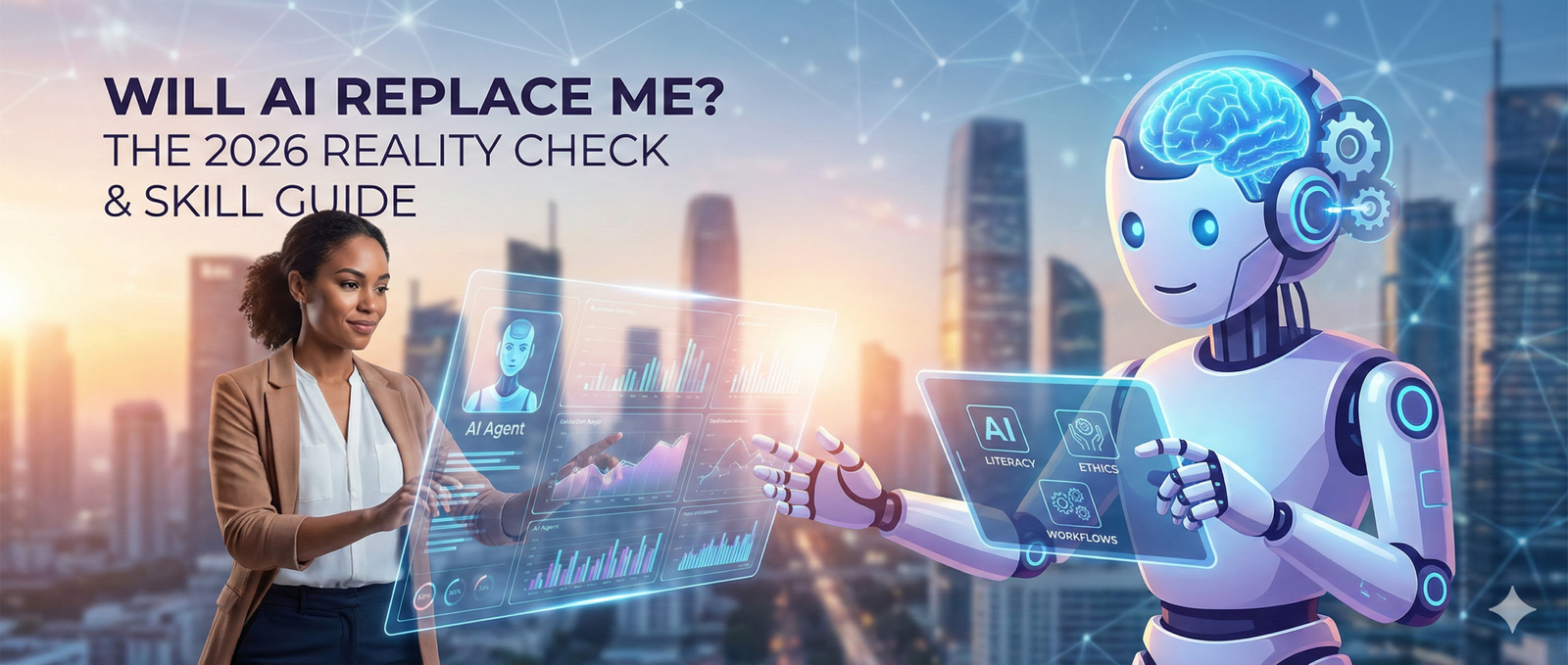
The Shift: From Coder to Conductor
Remember when everyone said “learn to code”? That advice aged like milk. Some developers now report that 90% of the code they write is AI-generated MIT Technology Review. AI is estimated to replace 8.1% of the total global workforce DemandSage, with junior-level coding roles particularly vulnerable.
The modern workforce has divided into two distinct camps:
The Task Executors: People who manually write emails, format spreadsheets, draft reports line-by-line, and code functions from scratch. These roles are shrinking rapidly.
The Orchestrators: People who design workflows, manage AI agents, evaluate outputs, and make strategic decisions. These roles are exploding.
The difference? Professionals with specialized AI skills now command salaries up to 56% higher than peers in identical roles without those skills Gloat.
2026 Is the Year of Agentic AI
The biggest shift in 2026 isn’t better chatbots—it’s the rise of AI agents that do things, not just say things.
Google Cloud’s 2026 AI Agent Trends Report forecasts that AI agents will fundamentally reshape business, with more than 57,000 team members at Telus regularly using AI and saving 40 minutes per AI interaction Google. IDC expects AI copilots to be embedded in nearly 80% of enterprise workplace applications Salesmate by the end of this year.
What does this actually mean? Instead of asking ChatGPT to write an email, you now have agents that:
- Monitor your inbox continuously
- Flag urgent messages based on learned priorities
- Draft replies in your style
- Schedule meetings automatically
- Create presentations, spreadsheets, and reports without switching tools
Agentic AI has become an integrated team member, closing the gap between people and AI Cisco. Companies aren’t asking if they should adopt agents—they’re asking who on their team knows how to manage them.
Three Skills That Actually Matter in 2026
If you work in marketing, HR, operations, sales, or any non-technical role, here’s what employers are desperately hiring for right now:
1. Systems Thinking (Not “Prompt Engineering”)
Early prompt engineering was about finding magic words. That era is dead. In 2026, prompt engineering is being absorbed into something bigger—building systems around AI Medium.
The Old Way: “ChatGPT, write me a blog post about coffee.”
The 2026 Skill: Designing multi-step workflows where one agent researches competitor content, another identifies gaps, a third drafts sections addressing those gaps in your brand voice, and a fourth converts it into social posts—all while you focus on strategy and final approval.
Resume Bullet: “Designed automated content workflows using AI agents, reducing production time by 65% while maintaining brand consistency across 5 platforms.”
2. The AI Auditor (Output Evaluation & Ethics)
AI still hallucinates. It still generates biased content. It still creates legal nightmares when untrained employees paste confidential data into public chatbots.
66% of leaders say they wouldn’t hire someone without AI skills, and 71% say they’d rather hire a less experienced candidate with AI skills than a more experienced candidate without them EDUCAUSE Review. But what they really need are people who can catch AI mistakes before they cause damage.
The Skill: Fact-checking AI outputs, understanding data privacy implications, spotting copyright risks, and knowing when AI is confidently wrong.
Resume Bullet: “Implemented human-in-the-loop quality assurance protocols for AI-generated customer communications, achieving 100% compliance and zero escalations over 6 months.”
3. Agent Management (The Digital Team Leader)
This is where the real opportunity lies in 2026. Approximately 40% of enterprise applications now include autonomous AI Agents, moving from simple assistance to executing entire business workflows independently Salesmate.
The Skill: Using platforms like Microsoft Copilot, Salesforce Agentforce, or Google’s Gemini to chain tasks together. Not just using AI tools—orchestrating them like a conductor leads an orchestra.
Real Examples:
- Marketing: An agent that transforms one blog post into a LinkedIn carousel, Instagram captions, email newsletter, and Twitter thread—each optimized for platform and audience
- Operations: An agent that monitors project delays, automatically reschedules dependent tasks, notifies stakeholders, and updates dashboards in real-time
- Sales: An agent that researches prospects, drafts personalized outreach, schedules follow-ups, and updates CRM records—all while you focus on high-value conversations
Resume Bullet: “Deployed AI agent workflows that automated 18 hours of weekly administrative tasks, enabling team to increase client capacity by 40% without additional headcount.”
What About Coding? Is It Dead?
No—but it’s transformed. Learning to code in 2026 isn’t less valuable because of AI—it’s more valuable, but for different reasons AlgoCademy.
The reality: developers spend only 20% to 40% of their time coding, with the rest analyzing problems, dealing with customer feedback, product strategy, and administrative tasks MIT Technology Review. AI has automated some of the coding part, but it can’t handle the strategic thinking.
What changed: The job isn’t writing syntax anymore—it’s understanding systems well enough to direct AI to write the right code, then evaluating if it actually works. The key is using AI as a tutor, not as a replacement for your own thinking AlgoCademy.
For non-coders: You don’t need to become a developer. But understanding how systems work—the logic, the architecture, the cause-and-effect—gives you a massive advantage when managing AI agents.
The Uncomfortable Truth
Currently, 37% of business leaders report they expect to replace human workers with AI by the close of 2026 DemandSage. Goldman Sachs Research warns that AI can potentially automate tasks that account for 25% of all work hours in the U.S. Axios
But here’s what the data also shows: AI doesn’t eliminate work—it eliminates tolerance for average performance CLICKVISION Digital. The people being replaced aren’t those doing valuable work—they’re those doing work that AI can do faster, cheaper, and at scale.
The survivors? Those who treat AI like the world’s most capable intern: tireless, fast, and excellent at execution—but requiring clear direction, quality control, and strategic oversight.
Don’t Compete. Collaborate.
You can’t outpace AI on speed. AI agents are set to become digital coworkers, helping individuals and small teams punch above their weight Microsoft News. A three-person team with strong AI skills can now accomplish what took a 15-person team just two years ago.
But AI can’t negotiate a sensitive deal. It can’t read the emotional temperature of a Zoom call. It can’t decide which strategy is right—only execute the one you give it. The era of simple prompts is over—enterprises are moving to agentic workflows that orchestrate complex, end-to-end processes Google.
Your job in 2026 is not to be the machine. It’s to be the pilot.
Ready to Start? Do This Today:
Week 1: Pick one repetitive task you hate—scheduling, meeting notes, first-draft emails, data entry. Spend 2 hours learning how an AI agent can do it. YouTube has hundreds of tutorials for every major tool.
Week 2: Set up one automated workflow. Start simple. Even automating your meeting notes or email triage is a resume-worthy accomplishment.
Week 3: Document what you learned. Write bullet points for your resume. Quantify the time saved. That documentation is your proof of AI literacy.
Then scale. Every workflow you automate frees time for higher-value work—the kind AI can’t do, and the kind that makes you irreplaceable.
The professionals winning in 2026 aren’t the ones with the most credentials. They’re the ones who learned to conduct the orchestra—while others are still arguing about whether the robots are coming.
The robots are already here. The question is: are you leading them, or watching from the sidelines?



Leave a Comment
You must be logged in to post a comment.