
There are 572,000 unfilled cybersecurity jobs in the United States right now. The average time-to-fill for a senior security role is 21% longer than any other IT position. Companies are not just struggling to find people. They are struggling to find people who can prove — with a credential a hiring manager trusts — that they have the skills to actually do the job.
That verification gap is why cybersecurity certifications carry salary weight that no other IT credential category matches. A CISSP holder earns a median US base salary of $134,000. A CISO with a CISM earns over $189,000. An elite penetration tester with an OSCP commands $115,000–$160,000 — without managing anyone.
But not all certs are equal. Some open doors. Some are checkbox credentials that look good on a job description but produce eye-rolls in technical interviews. And some are genuinely hard to earn and worth every hour of suffering.
This guide tells you which is which — and gives you the specific numbers to make the right call for your career stage.
The Five Certifications That Actually Move the Salary Needle
One important distinction before we start: the salary figures below represent what professionals in those roles typically earn. A certification alone does not guarantee these numbers. What it does is make you eligible for roles you could not reach without it, and signal to hiring managers that you meet the standard for serious consideration.
That distinction matters. Keep it in mind.

1. CISSP — The Credential That Gets You Into the Room Where Decisions Are Made
The Certified Information Systems Security Professional is the most requested cybersecurity certification in US job postings. Not one of the most. The most.
It is not a technical certification in the same sense as OSCP. You will not learn to hack a machine by studying for CISSP. What it tests instead is whether you can think at the level of a security program architect — someone who understands risk across eight domains simultaneously, can communicate it to a board of directors, and knows how to build, manage, and govern an entire security function.
That is worth a lot of money. Because very few people can do it.
The eight CISSP domains:
| Domain | Weight in Exam |
|---|---|
| Security and Risk Management | 16% |
| Asset Security | 10% |
| Security Architecture and Engineering | 13% |
| Communication and Network Security | 13% |
| Identity and Access Management (IAM) | 13% |
| Security Assessment and Testing | 12% |
| Security Operations | 13% |
| Software Development Security | 10% |
Exam and cost breakdown:
| Item | Detail |
|---|---|
| Governing body | (ISC)² |
| Exam format | Adaptive CAT — 100 to 150 questions / 3 hours |
| Exam cost | $749 |
| Prerequisites | 5 years full-time experience in ≥2 domains (4 years with a relevant degree) |
| Maintenance | 120 CPE credits over 3 years + $135 annual fee |
What CISSP earns you:
| Role | Average US Salary |
|---|---|
| Security Architect | $155,000–$175,000 |
| Senior Security Consultant | $135,000–$155,000 |
| CISO (mid-market company) | $180,000–$220,000 |
| IT Security Manager | $120,000–$145,000 |
India context: CISSP is the primary credential for senior security roles in Indian MNCs — Infosys, TCS, Wipro, HCL — and for positions at the Big 4 consulting firms in India. Mid-level holders with 7–10 years of experience typically earn ₹22–₹40 LPA. CISO-track roles in large enterprises start at ₹45 LPA and scale significantly.
The thing nobody tells you about CISSP requirements: If you pass the CISSP exam but do not yet have the full five years of experience, you do not lose your result. You become an Associate of (ISC)² — a formal status that allows you to study, sit, and pass the exam now, then convert to full CISSP certification once your experience accumulates. You have six years to complete the experience requirement after passing. For professionals at the 3–4 year experience mark who want to sit the exam before they technically qualify, this is the official, legitimate path. Most comparison articles mention it in one line. It deserves to be the centrepiece of your planning if you are close but not quite there.
2. CISM — The Business Case for Security, in Certification Form
Where CISSP proves breadth across all eight security domains, CISM proves something more specific: you understand how to run a security function as a business. Risk alignment. Governance frameworks. Incident response from a management perspective. Reporting to the board.
CISM is ISACA’s credential. And ISACA’s focus has always been governance — audit, control, risk. The professionals who hold CISM tend to come from IT audit backgrounds, IT risk management, or senior IT administration roles. It is a natural next step for that profile.
Exam and cost:
| Item | Detail |
|---|---|
| Governing body | ISACA |
| Exam format | 150 MCQ / 4 hours |
| Exam cost | $575 (ISACA member) / $760 (non-member) |
| Prerequisites | 5 years information security experience, 3 years in management role |
| Maintenance | 120 CPE hours over 3 years + annual fee |
| CISSP waiver | Holding CISSP can waive up to 2 years of experience requirement |
What CISM earns you:
| Role | Average US Salary |
|---|---|
| Information Security Manager | $125,000–$145,000 |
| IT Director (security focus) | $140,000–$160,000 |
| CISO | $175,000–$210,000 |
| Risk & Compliance Director | $130,000–$155,000 |
CISM vs. CISSP — which one? They are not competitors; they are complements. But if you can only do one, the choice depends on your role. If you are in a hands-on security architect or technical leadership role, start with CISSP — it is more universally recognised and covers more ground. If you are in IT audit, IT risk, or compliance, CISM is more directly relevant and often more valued by employers in those specific functions.
CISM holders report average total compensation (base + bonus) of $165,000+. The base salary average sits around $149,000. At the CISO level, CISM holders consistently push past $189,000.
3. OSCP — The Hardest Cert in This List, and the One With the Most Unfiltered Street Credibility
Let me be very clear about what the OSCP is: it is not a multiple-choice exam. There is no question bank to memorise. There is no way to guess your way through it.
The OSCP exam is 24 hours. You are given access to a network of deliberately vulnerable machines. Your job is to compromise as many of them as possible, document every step of your methodology, and submit a professional penetration testing report within the following 24 hours. That is 48 consecutive hours of exam pressure. You either hack the machines or you do not. The exam does not care why you could not.
This is why the OSCP carries a different kind of weight in the security community. When a hiring manager sees OSCP on a resume, they know the candidate has actually hacked live systems under time pressure and written a report about it. That is not something you can fake.
Exam and cost:
| Item | Detail |
|---|---|
| Governing body | OffSec |
| Prerequisite | PEN-200 course (mandatory — must be purchased) |
| Exam format | 24-hour practical hacking exam + 24-hour report submission |
| Starting cost | ~$1,749 (includes PEN-200 course + lab access + exam attempt) |
| Maintenance | Standard OSCP: lifetime. OSCP+: renewal every 3 years |
| Recommended background | Networking fundamentals, Linux command line, basic scripting |
What OSCP earns you:
| Role | US Salary Range |
|---|---|
| Penetration Tester (junior) | $80,000–$110,000 |
| Penetration Tester (mid-level, OSCP) | $115,000–$145,000 |
| Red Team Operator | $130,000–$165,000 |
| Lead Penetration Tester | $145,000–$180,000+ |
Honest word of warning: OSCP has a meaningful failure rate. Many candidates attempt it two or three times before passing. The preparation pathway matters enormously. Before you buy the PEN-200 course, spend 3–6 months working through free platforms like TryHackMe (beginner-to-intermediate rooms) and HackTheBox (intermediate machines). When you can consistently compromise intermediate-difficulty HackTheBox machines without hints, you are approximately ready to purchase the PEN-200. Going in before that point wastes your lab time and increases the likelihood of a failed first attempt.
4. CEH — Useful, Widely Recognised, and Genuinely Controversial
I am going to be honest about something that most certification guides skip entirely: the CEH is polarising in the cybersecurity professional community.
Many experienced penetration testers consider CEH a knowledge-based checkbox credential — useful for passing HR keyword filters and demonstrating foundational attacker methodology, but not evidence of actual hacking ability. The criticism is fair. The CEH is a 125-question multiple-choice exam. You can learn attacker tools and techniques well enough to answer exam questions without ever successfully compromising a real machine.
OSCP holders tend to be dismissive of CEH. Government and compliance-heavy employers tend to respect it. The reality is somewhere in the middle.
Where CEH genuinely earns its place:
- Federal government roles and defence contractors, where certifications must appear on approved lists (DoD 8570/8140 approved — the same framework that endorses Security+, CISSP, and others)
- Corporate security analyst roles where the employer values a recognised brand name and structured knowledge framework
- Entry to the offensive security career track, before you are ready for OSCP
Think of CEH as the credential that gets you into the penetration testing interview. OSCP is the credential that gets you the job.
Exam and cost:
| Item | Detail |
|---|---|
| Governing body | EC-Council |
| Exam format | 125 MCQ / 4 hours |
| Exam cost (voucher) | ~$1,199 |
| Official training cost | $1,699–$3,499 |
| Prerequisites | Official training OR 2 years information security experience |
| Maintenance | 120 continuing education credits over 3 years + $80 annual fee |
What CEH earns you:
| Role | US Salary Range |
|---|---|
| Security Analyst (CEH) | $85,000–$115,000 |
| Vulnerability Analyst | $90,000–$120,000 |
| Penetration Tester (entry-level) | $95,000–$125,000 |
| Security Consultant | $110,000–$145,000 |
Average total compensation for CEH holders sits between $126,000 and $136,000 across all experience levels. At the mid-level, it punches at a similar weight to CompTIA CASP+ and Sec+, but below OSCP.
5. CompTIA Security+ — The Certification That Opens More Doors Than Any Other on This List
Security+ is not the highest-paying certification here. But it may be the most strategically important, and here is why: it is the baseline requirement for tens of thousands of cybersecurity jobs — including virtually every US federal government and DoD-adjacent cybersecurity role.
It is vendor-neutral. It covers a broad sweep of core security concepts — network security, cryptography, threat intelligence, identity management, incident response — without going deep on any single platform or methodology. That breadth is both its limitation and its value. A hiring manager at a federal agency or a large enterprise does not need to know your preferred hacking tool. They need to know you understand the foundational theory that makes security decisions coherent. Security+ proves exactly that.
Exam and cost:
| Item | Detail |
|---|---|
| Governing body | CompTIA |
| Exam format | Up to 90 questions (MCQ + performance-based) / 90 minutes |
| Exam cost | $425 |
| Prerequisites | None required (Network+ and 2 years IT experience recommended) |
| Maintenance | 50 CEUs over 3 years / $150 renewal fee OR retake exam |
| DoD 8140 approved | Yes — required baseline for many government security roles |
What Security+ earns you:
| Role | US Salary Range |
|---|---|
| Security Administrator | $75,000–$100,000 |
| SOC Analyst Tier 1 | $65,000–$90,000 |
| IT Security Specialist | $80,000–$110,000 |
| Security Engineer (entry) | $90,000–$125,000 |
India context: For Indian IT professionals in the 2–4 year experience bracket, Security+ is increasingly requested by global clients and MNC employers as a minimum security baseline. It typically pushes compensation from ₹6–₹8 LPA to ₹9–₹14 LPA for security-adjacent roles. In the GCC (Gulf Co-operation Council) market — UAE, Saudi Arabia, Qatar — Security+ is commonly listed as a minimum requirement for government IT security contracts.
The Full Comparison: Side by Side
| Certification | Who It’s For | Exam Cost | Total Investment | Avg. US Salary | Difficulty |
|---|---|---|---|---|---|
| CISSP | Security architects, CISO track | $749 | $1,500–$3,000+ | $134,000–$175,000 | High |
| CISM | Security managers, IT risk leaders | $575–$760 | $1,200–$2,500+ | $149,000–$189,000 | High |
| OSCP | Offensive security, pentesters | Included in $1,749 bundle | $1,749–$2,500+ | $115,000–$165,000 | Very High |
| CEH | Security analysts, aspiring pentesters | ~$1,199 (voucher) | $2,000–$4,500 | $110,000–$136,000 | Medium |
| Security+ | Everyone entering cybersecurity | $425 | $600–$1,200 | $75,000–$125,000 | Low-Medium |
The Two Career Tracks — and How to Stack Certs on Each
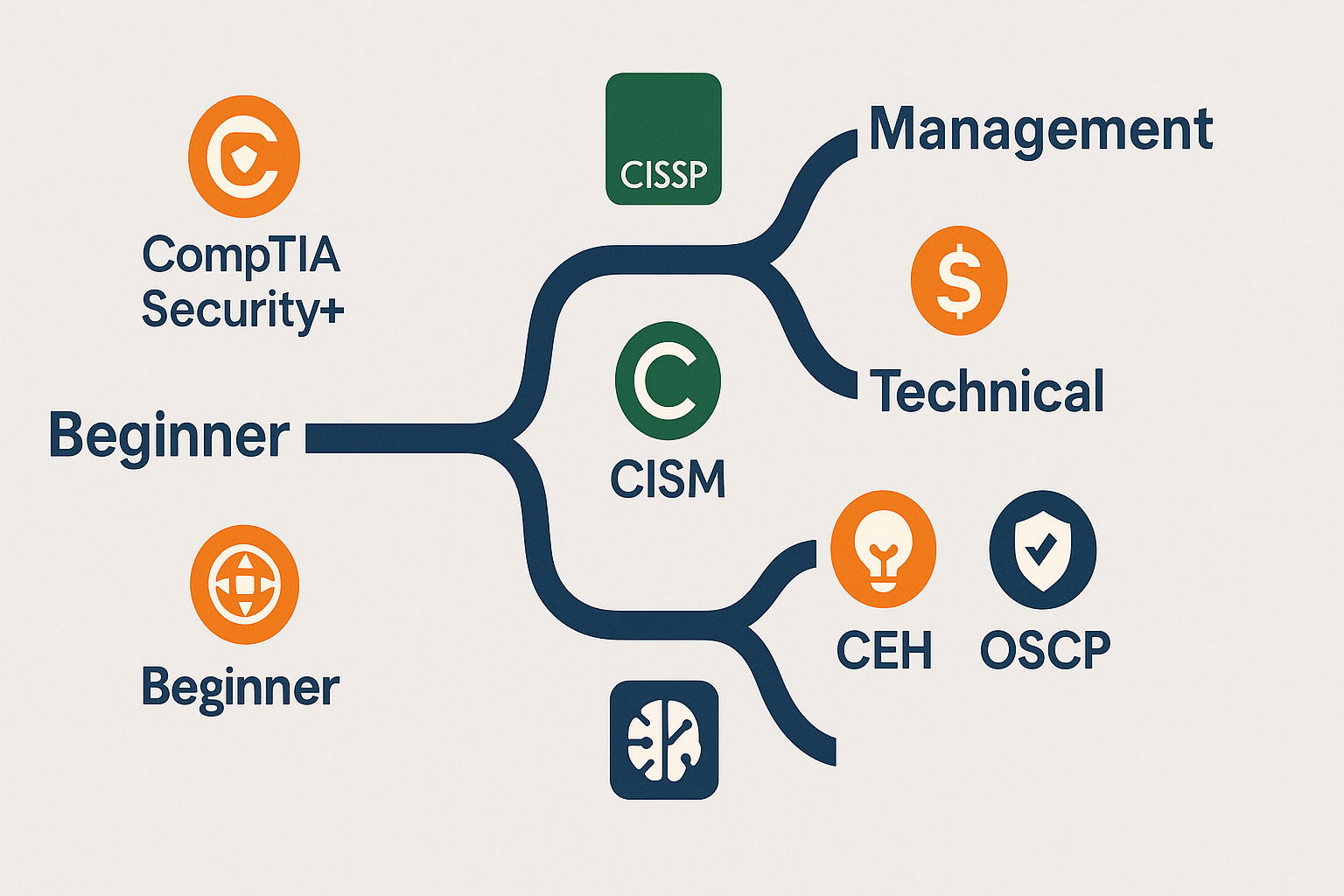
Every cybersecurity career eventually sorts into one of two directions. Defensive / governance (you protect and manage) or offensive / technical (you attack and expose). Your cert stack should reflect which track you are on.
Defensive / Governance Track
This is the path to CISO, Security Director, IT Risk Management, and Compliance leadership. The salary ceiling is genuinely high — CISOs at large enterprises earn $250,000–$400,000+ in total compensation. The trade-off is that it takes time. You cannot shortcut the experience requirements.
Recommended stack, in sequence:
Year 0–2: CompTIA Security+ → establishes foundational credibility, satisfies DoD baseline, gets you into entry-level roles.
Year 2–4: Work toward CISSP Associate of (ISC)² → sit the exam before full eligibility, bank the pass, convert to full CISSP when experience threshold is met.
Year 5+: CISM → adds governance and management specialisation, opens CISO track roles.
Offensive / Technical Track
This is the path to penetration tester, red team operator, vulnerability researcher, and offensive security consultant. The salary ceiling is strong at the elite level, and you can reach it without ever managing people — which suits a particular kind of professional perfectly.
Recommended stack, in sequence:
Year 0–1: CompTIA Security+ → get your baseline, start building network and Linux fundamentals.
Year 1–2: CEH → learn attacker methodology formally, satisfy government/enterprise checkbox requirements, start building lab experience.
Year 2–4: OSCP → prove you can actually do it. This is the credential that converts a security analyst into a pentester in the eyes of serious employers.
Year 4+: Consider OffSec OSEP (Experienced Penetration Tester) or OSED (Exploit Developer) — these are the elite-tier OffSec certs above OSCP, and they command premium salaries in red team and vulnerability research roles.
What the Big Career Sites Won’t Tell You
The (ISC)² website, the EC-Council blog, and the CompTIA learning resources all have one thing in common: they are written by organisations who sell the certifications they are describing. Here is the context they leave out.
1. CEH has a reputation problem in offensive security job interviews — and you should know about it before spending $4,500.
A meaningful segment of hiring managers for penetration testing roles — particularly at boutique security consultancies, red team practices, and security-first companies — view CEH as insufficient proof of real offensive skill. The phrase “CEH is a good starting point” is polite industry language for “we require something more.” If your goal is a hands-on pentesting role at a serious security shop, plan for OSCP from the beginning and treat CEH as an optional intermediate step, not a destination. If your goal is a security analyst role at a bank, an enterprise IT department, or a government contractor, CEH is perfectly respected and widely accepted. Know your target employer type before you decide.
2. The real cost of CISSP is not the exam fee — it is the CPE maintenance over three years, and most new holders do not budget for it.
The $749 exam fee is what you see in every cost comparison. What you also pay: $135/year in (ISC)² annual fees ($405 over the 3-year cycle), plus the time and occasional cost of earning 120 CPE credits. Some CPE sources are free — (ISC)² webinars, reading security publications, contributing to the community. Others cost money — conferences, additional courses, paid training. Budget $200–$500 in CPE-related costs per year on top of the annual fee. For a certification that compounds in value over a 20-year career, this is genuinely worth it. But candidates who only budget for the exam fee end up surprised when renewal arrives.
3. If you want maximum job opportunities in the US federal market, the cert order that matters most is Security+ → CySA+ → CISSP — not the order most general career guides recommend.
The US Department of Defense Directive 8140 (which replaced 8570) classifies approved certifications by work role and level. Security+ covers many IAM Level 1 and CSSP roles. CySA+ (CompTIA Cybersecurity Analyst) covers CSSP Analyst roles. CISSP covers IAM Level 3 and CSSP Infrastructure Support roles. If federal or DoD-adjacent contracting is your target market — and it is a massive, stable, well-paying market — your certification roadmap should be built around the 8140 framework, not around general industry salary surveys. Search “DoD 8140 approved certifications list” and cross-reference it with the specific work roles you are targeting. Most career guides do not mention this framework at all, which means most candidates optimising for the federal market are studying the wrong certs in the wrong order.
Frequently Asked Questions
Can I take CISSP if I don’t have 5 years of experience yet?
Yes — and this is genuinely underused. Pass the exam, become an Associate of (ISC)², and you have six years to complete the experience requirement. It is the official path for candidates who are close but not yet fully eligible. Do not wait until you have five years to start studying.
Is OSCP worth it if I have no hacking experience?
Not yet. OSCP assumes you already have solid networking knowledge, Linux command line fluency, and basic scripting skills. Before purchasing the PEN-200 course, spend 3–6 months on TryHackMe (complete the “Jr Penetration Tester” learning path) and HackTheBox (target Easy and Medium difficulty machines without hints). When you can do those consistently, you are ready to invest in OSCP.
Which certs does the US federal government require?
The DoD 8140 directive specifies approved certifications by work category and level. Security+ is the most widely required baseline, appearing across multiple work roles. CISSP covers senior architecture and management roles. CEH is DoD 8140 approved for CSSP Analyst and Incident Responder categories. Check the specific 8140 work role that matches your target position for the exact cert requirements.
What is the fastest way into cybersecurity from zero experience?
Google Cybersecurity Professional Certificate on Coursera (3–6 months, ~$300 total) → CompTIA Security+ (2–3 months additional study, $425 exam). This sequence gets you from zero to a credentialed entry-level candidate in under a year for roughly $800 in total investment. Security+ is explicitly what the Google cert prepares you for — they are designed as a sequence.
How does India’s cybersecurity cert market differ from the US?
In India, CISSP and CISM are the senior-level gold standards, respected by MNCs and large Indian enterprises alike. CompTIA Security+ is growing in recognition, particularly for client-facing roles with global companies. CEH has strong brand recognition in India — partly because EC-Council was founded in the US but has deep roots in the Indian market — and is often the first offensive security credential Indian professionals pursue. OSCP recognition is growing, particularly in firms that serve global clients, but it remains less commonly required in Indian domestic job descriptions than in the US.
Which cybersecurity cert has the best ROI for someone mid-career?
If you have 5+ years of IT experience and are moving into security leadership: CISSP, because it directly unlocks roles that pay $50,000–$70,000 more than your current position. If you have 3–5 years in IT and want to pivot to hands-on security: OSCP, because it is the single credential that convinces a pentesting employer to take a career-changer seriously. If you are in IT audit or compliance moving into security management: CISM, because ISACA’s governance framework maps directly to what those roles require.
The Bottom Line
Five certifications. Two career tracks. One decision.
The highest-paying credential is not the CISSP or the CISM, though both pay extremely well. The highest-paying credential is the one that is most misaligned with supply in your specific market. Right now, OSCP-certified pentesters are in critically short supply relative to demand — which is why lead penetration testers command $160,000+ without touching a management role. CISM-certified security managers with genuine governance experience are similarly rare, which is why CISO compensation at large enterprises continues to climb.
Pick the track that suits how your brain works. Not the salary number next to the certification name.
If you attack problems instinctively, break things to understand them, and think in terms of exploit chains and system weaknesses — the offensive track and the OSCP are built for you.
If you think in frameworks, risk matrices, and board communication — the governance track and the CISSP-to-CISM sequence is where you belong.
Both tracks pay very well. Neither is the wrong answer.
Updated April 2026. Salary figures are US-market estimates from published compensation surveys and reflect total cash compensation across experience levels, not guaranteed outcomes from certification alone. India figures are estimates based on IT sector benchmarks. Always verify current exam fees directly with (ISC)², ISACA, EC-Council, OffSec, and CompTIA before purchasing.
Discover more from Skill Upgrade Hub
Subscribe to get the latest posts sent to your email.


