As of February 2026, India has 39,890 DGCA-certified remote pilots, 38,500+ registered drones, and 244 approved training organisations operating across the country, according to government data compiled by A2Z Taxcorp from official DGCA and Digital Sky records. The market is projected to grow at over 20% CAGR through 2030, with government estimates placing the sector’s value at ₹50,000 crore by that year.
This is not a niche hobby industry edging toward legitimacy. It is an active employment sector with a regulatory framework, named employers, published salary ranges, and three specific industry verticals generating the bulk of paid work in 2026.
If you have been searching for drone pilot career information and finding only USD-denominated American guides built around FAA Part 107 regulations, this article is the corrective. Every salary figure here is in rupees, every regulatory reference is DGCA, and every employer named is Indian or operating in the Indian market.
Why 2026 Is a Structural Inflection Point for Indian Drone Careers
Three policy changes, all now active, have created conditions that did not exist before 2022:
The Drone Rules 2021 replaced the older UAS Rules 2021, dramatically simplifying compliance. The number of forms required to operate commercially dropped from 25 to 6. Approvals that previously required manual processing are now largely handled through the Digital Sky platform and its successor portal eGCA.
The PLI (Production Linked Incentive) Scheme for Drones allocated ₹120 crore to support domestic drone manufacturers. A successor “Drone Shakti” mission is under consideration with a potential outlay of ₹10,000 crore including capital subsidies. The direct effect: Indian companies like ideaForge, Garuda Aerospace, and Aarav Unmanned Systems have expanded production capacity. These companies are now hiring at scale.
The import ban on foreign commercial drones (February 2022) prohibited the import of foreign drones for most commercial use categories. This single policy decision changed the equipment landscape entirely. DJI — the dominant global drone brand — is restricted from most government contracts in India. Indian-manufactured drones now power the majority of commercial and government operations. What this means for your career is covered in a later section.
The combined result: India had roughly 4,200 registered drones and a handful of large RPTO organisations in 2021. By February 2026, that number had grown to 38,500+ registered drones and 244 approved training organisations nationwide — a near-tenfold increase in just four years. The SVAMITVA scheme alone surveyed 3.28 lakh villages using drones as of December 2025, creating sustained operational demand.
What Drone Pilots Actually Do in India: Three Sectors Worth Understanding
The work that pays in India’s drone sector in 2026 falls into three clear verticals. Understanding which one you are targeting before you train determines which equipment you need to learn, which companies to approach, and what your realistic income trajectory looks like.
Sector 1: Government Mapping and Land Surveying
This is the single largest organised source of drone pilot work in India right now, driven primarily by two government programmes.
SVAMITVA Yojana (Survey of Villages and Mapping with Improvised Technology in Village Areas) is implemented by the Ministry of Panchayati Raj in coordination with the Survey of India and state governments. Drones are used to create aerial maps of rural abadi areas to generate property cards for village households. As of December 2025, drone surveys have been completed in 3.28 lakh villages — approximately 95% of the total target of 3.44 lakh villages — and 2.76 crore property cards have been prepared across 1.82 lakh villages in 31 states and UTs.
The work involves flying systematic grid patterns over village areas, maintaining flight logs, coordinating with state revenue officials, and delivering processed orthomosaic data to Survey of India standards. Pilots on SVAMITVA assignments typically work in teams, supervised by Survey of India-empanelled survey companies.
NHAI (National Highways Authority of India) mandates monthly drone video recordings for all active highway projects. Any construction contractor working on a national highway project must comply. This has created consistent, recurring work for drone operators tied to the civil construction industry — a sector where contracts run years, not weeks.
Government mapping work pays less per day than private industrial inspection but offers something private work doesn’t: multi-month or multi-year contracts with predictable scheduling. Entry-level survey operators on state government drone programmes typically earn in the ₹15,000–₹25,000 per month range. Experienced pilots managing a crew and delivering processed map data to Survey of India standards earn ₹30,000–₹50,000 per month.
Sector 2: Precision Agriculture
India’s agriculture drone market is being pushed from both sides simultaneously — government subsidy schemes from the top, and farmer demand for efficiency from the bottom.
The Namo Drone Didi scheme, launched in November 2023, distributed drones to Women Self-Help Groups (SHGs) for agricultural services. The scheme has deployed 1,094 drones to women SHGs, with 500+ under the Namo Drone Didi initiative specifically. States are running parallel programmes: Tamil Nadu offers 100% free drone training for organic farmers, Maharashtra provides an extra ₹1 lakh subsidy to Farmer Producer Organisations (FPOs) purchasing drones, and Uttar Pradesh and Telangana are running pilot integration projects in sugarcane and rice.
Pradhan Mantri Fasal Bima Yojana (PMFBY) — the crop insurance scheme — uses drone-based crop monitoring for field verification, reducing the time for claim assessment from weeks to days.
ICAR (Indian Council of Agricultural Research) has been running drone spraying trials and training programmes since 2021, covering precision irrigation, crop disease detection, and smart spraying. Agriculture is the sector with the highest demand for drone operators in rural and semi-urban India.
Agriculture drone pilots typically operate agricultural spraying drones (multi-rotor platforms carrying 10–16 litres of pesticide or fertiliser) or multispectral imaging drones for crop health analysis. The work is seasonal — concentrated around kharif (June–October) and rabi (November–March) cropping cycles — but within those windows, operators can complete multiple jobs per day.
Per-acre rates for drone spraying vary by state and crop type: ₹300–₹600 per acre is a common range for pesticide/fertiliser application. A productive day covering 60–80 acres generates ₹18,000–₹48,000 in gross revenue, though equipment, chemical, and travel costs reduce net income considerably. Full-time agriculture drone operators working under FPO or state government contracts typically earn ₹20,000–₹40,000 per month in-season.
Sector 3: Industrial Inspection and Infrastructure
This is the highest-compensation vertical in India’s drone sector, closest to the US industrial drone model, but with India-specific employer dynamics.
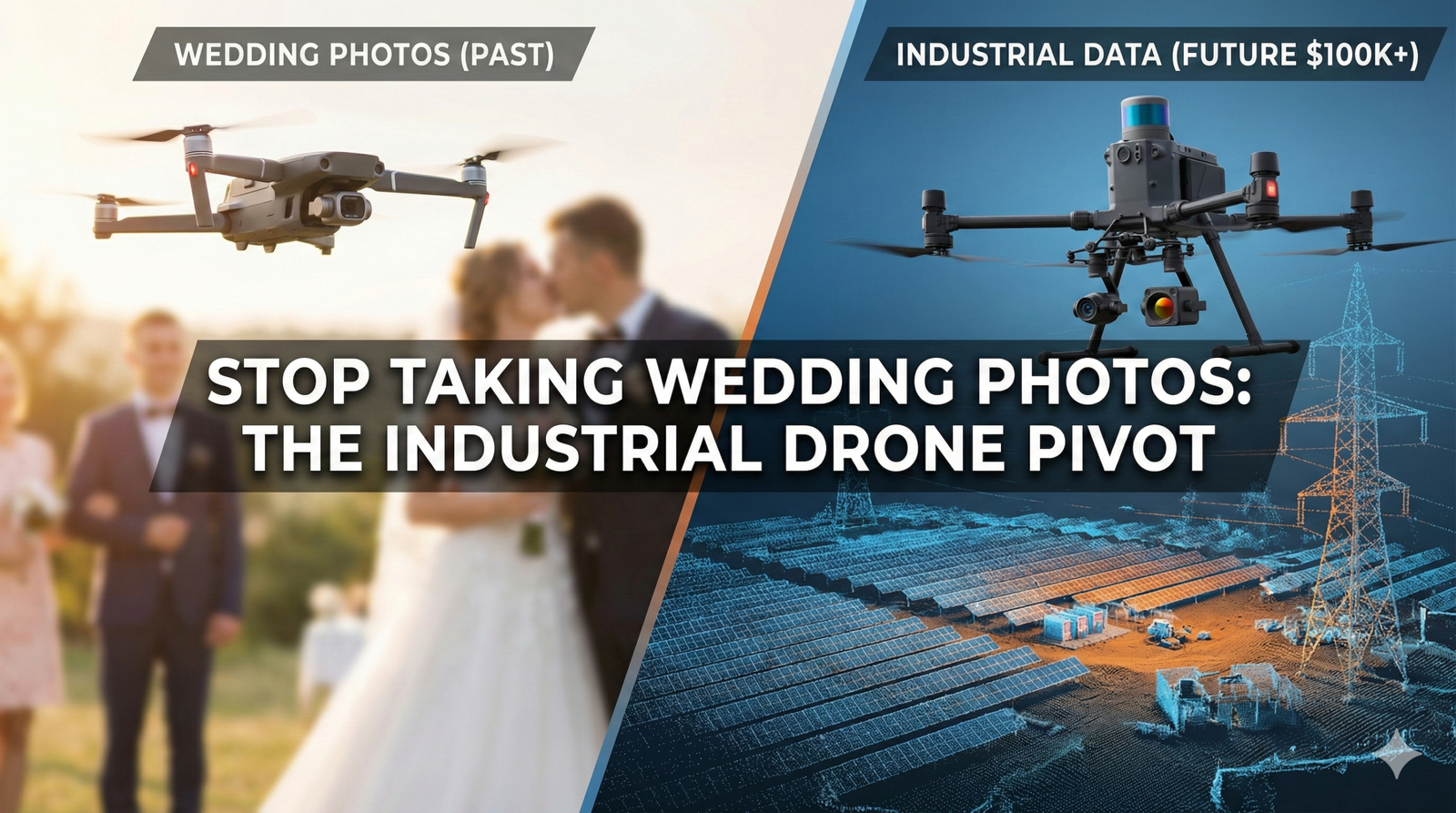
The core work involves thermal and visual inspection of solar farms, electricity transmission towers and lines (POWERGRID contracts), pipeline and oil infrastructure, railway infrastructure (Indian Railways has been trialling drone-based track inspection), and construction site photogrammetry for large infrastructure projects.
Solar farm inspection is growing alongside India’s renewable energy push. As of 2026, India has over 80 GW of installed solar capacity, with thousands of utility-scale and rooftop solar farms requiring annual maintenance inspection. Drone thermal imaging identifies failing cells, string faults, and hotspots far faster and more completely than manual inspection.
Industrial inspection rates in India are not yet published on standard salary platforms in meaningful sample sizes. Market rates gathered from industry sources (drone service company tariff sheets and government tender documents) suggest: solar farm inspection at ₹500–₹2,000 per MW for smaller operators, ₹100–₹500 per MW for larger contracted inspection companies. Infrastructure inspection day rates for experienced operators with equipment run ₹8,000–₹25,000 per day.
Experienced industrial drone pilots employed full-time at inspection service companies or OEM service divisions in India typically earn ₹4–₹10 LPA. Those with 5+ years of experience, thermal certification, and photogrammetry skills working for larger companies or as independent operators earn ₹10–₹18 LPA.
Verified Salary Data by Employer: What Indian Companies Actually Pay in 2026
The following figures are drawn from Glassdoor India employer-submitted salary data (January–April 2026) with 50+ total submissions across the drone pilot category. The Indeed India figure (₹2.37 lakh/month average) is based on only 29 responses and appears heavily skewed by aeronautical engineer roles included in the same search — treat it as an outlier, not a benchmark.
ideaForge Technology (NSE-listed, India’s largest drone OEM): ₹25,000–₹45,000 per month, median ₹35,000 (~₹4.2 LPA). ideaForge currently shows 60 open drone pilot positions on Glassdoor — the highest active hiring count of any single company in India. Primary roles: survey operations, SVAMITVA project assignments, defence sector drone operations (ideaForge supplies to Indian Army and paramilitary forces). DGCA RPC and prior ideaForge platform experience (NETRA, SWITCH, Q4i) are listed as preferred in most job descriptions.
Garuda Aerospace (Chennai-based, 300+ drone fleet operator): ₹10,000–₹18,000 per month at entry level, median ₹15,000 (~₹1.8 LPA). 8 active openings on Glassdoor as of April 2026. Garuda operates one of India’s largest commercial drone service fleets covering agriculture, surveillance, and infrastructure inspection. Entry pay is lower than ideaForge, reflecting higher volume of operators and more standardised field operations work.
Raphe mPhibr (defence-focused fixed-wing UAV manufacturer): ₹22,000–₹25,000 per month, median ₹24,000 (~₹2.9 LPA). Raphe focuses on fixed-wing UAV platforms for border surveillance and defence applications. Roles here require DGCA RPC plus additional MoD (Ministry of Defence) security clearance processes.
Aereo (drone service platform): ₹3–₹4 LPA. Aereo operates as a drone-as-a-service (DaaS) platform aggregating pilot operators. Pay reflects platform-model gig structure rather than full employment.
Salary Summary Table (India, 2026)
| Employer / Role Type | Entry (0–2 yrs) | Mid (3–6 yrs) | Senior (7+ yrs) |
|---|---|---|---|
| ideaForge (field operator) | ₹3–4.2 LPA | ₹5–8 LPA | ₹8–12 LPA |
| Garuda Aerospace (field operator) | ₹1.8–2.4 LPA | ₹3–5 LPA | ₹5–8 LPA |
| Government mapping (Survey of India/state contracts) | ₹1.8–3 LPA | ₹3.6–6 LPA | ₹6–10 LPA |
| Industrial inspection (solar, infra) | ₹3–5 LPA | ₹6–10 LPA | ₹10–18 LPA |
| Agriculture sprayer operator (seasonal, full-time equivalent) | ₹2.4–3.6 LPA | ₹3.6–6 LPA | ₹6–10 LPA |
| Defence/MoD UAV operator | ₹3–5 LPA + allowances | ₹6–10 LPA | ₹10–15 LPA |
Sources: Glassdoor India salary submissions (January–April 2026, 50+ responses); Harvey Biomedical India industry data; job listing analysis from Glassdoor, Naukri, and SimplyHired India (April 2026). All figures are gross CTC estimates.
The honest picture on salary: India’s drone pilot salaries are currently lower than the US equivalents in the original article by a factor of 5–10. This is a structural reality of the Indian market, not a flaw in the career path. The comparison to make is not India vs USA — it is drone piloting vs comparable Indian technical roles. A fresher hardware technician or field service engineer in India earns ₹2–3.5 LPA. A DGCA-certified drone pilot with survey or inspection specialisation earns ₹3.5–6 LPA within 2–3 years, in a sector with significantly less competition at the skilled end.
The DGCA Remote Pilot Certificate: Complete Step-by-Step Process
There is no legal route to commercial drone piloting in India without a DGCA Remote Pilot Certificate (RPC). Flying commercially without one is an offence under the Drone Rules 2021, attracting fines and potential legal action. Every reputable employer — ideaForge, Garuda, government contractors — lists DGCA RPC as a mandatory requirement in job descriptions.
The RPC is the Indian equivalent of a driving licence for drone operations. It is issued after completing training at a DGCA-approved Remote Pilot Training Organisation (RPTO) and clearing the required assessment. As of February 2026, there are 244 DGCA-approved RPTOs across India.
Eligibility:
- Minimum age: 18 years
- Minimum education: 10th standard (SSC) pass from a recognised board
- Medical fitness: Basic health certificate as required by DGCA/RPTO (no pilot-grade medical required)
Drone Categories and Which RPC You Need:
DGCA classifies drones by weight. For commercial career purposes, two categories matter:
Small Category (251g–2 kg): Covers most mapping and photography drones. Small RPC is the standard starting point for survey, real estate, and general inspection work.
Medium Category (2 kg–25 kg): Required for agricultural spraying drones (most agri-drones fall here) and heavier inspection platforms. Medium RPC requires first holding a Small RPC.
The Step-by-Step Process:
Step 1 — Register on the Digital Sky / eGCA platform Create an account at digitalsky.dgca.gov.in (operational services) and eGCA (registration and certification). Provide Aadhaar number and basic personal details. This is your unified account for all DGCA drone-related submissions.
Step 2 — Select a DGCA-approved RPTO The approved RPTO list is published on the DGCA website and updated periodically. Choose based on: proximity (in-person practical training is mandatory — online-only programmes are not DGCA-recognised), course fees, batch availability, and the training platforms they use (ideally matching the equipment used by employers you’re targeting).
Step 3 — Complete training at your RPTO Training duration: 5–10 days depending on drone category. The curriculum is standardised by DGCA and covers:
- Drone Rules 2021 and stakeholder regulations (approximately 1.5 hours)
- Basic principles of flight, aerodynamics (rotorcraft and fixed-wing) — ~2.5 hours
- ATC procedures and radio telephony — ~1 hour
- Weather and meteorology — ~1.25 hours
- Drone equipment maintenance and basic assembly — ~2 hours
- Risk assessment and flight logging — ~1.5 hours
- Simulator training — ~3 hours
- Practical flying sessions — ~4.5 hours
At completion, your RPTO issues a Training Completion Certificate, which they upload directly to the Digital Sky / eGCA platform.
Step 4 — Clear the DGCA RPC examination Online, computer-based test. Minimum passing score: 60%. The exam covers drone regulations, airspace management, meteorology, navigation, drone systems, and safety procedures. Results are typically declared immediately.
Step 5 — Submit RPC application on Digital Sky / eGCA Upload your Training Completion Certificate and exam result. Submit through the portal. Processing time varies but is typically within a few weeks.
Step 6 — Medical and police verification Basic health fitness certificate and police verification are required as part of the RPC process.
Validity: 10 years from date of issue. Renewal requires refresher training and medical recertification.
Total Cost Breakdown:
| Cost Component | Range |
|---|---|
| RPTO training (Small RPC) | ₹25,000–₹50,000 |
| RPTO training (Medium RPC upgrade) | ₹15,000–₹47,200 additional |
| Drone registration (UIN on Digital Sky) | ~₹5,000 |
| Medical certification | ~₹3,000 |
| Commercial drone insurance (annual) | ₹5,000–₹15,000 |
| Total (Small RPC, first-time) | ₹38,000–₹73,000 |
| Total (Medium RPC upgrade) | ₹50,000–₹1,05,000 cumulative |
Sources: FlapOne Aviation (DGCA-approved RPTO, Feb 2026 pricing); ThinkRobotics cost breakdown (July 2025); InsideFPV total cost analysis (January 2026).
Metro city RPTOs charge at the higher end; smaller certified institutes in Tier-2 cities offer equivalent certification at lower cost. The certificate belongs to you, not to any drone or employer — it is portable across jobs and platforms.
The DJI Restriction: What It Actually Means for Your Career
This is the section most career guides skip, and it is operationally important.
India banned the import of foreign commercial drones in February 2022 under the “Unmanned Aircraft System (Import) Rules, 2022,” specifically to push domestic manufacturing under Make in India. Chinese drones — including DJI, which holds approximately 70% of global commercial drone market share — are effectively barred from government procurement and most formal commercial contracts.
The practical consequences for a drone pilot career in India:
For government-contracted work (SVAMITVA, NHAI, state mapping, defence): You will almost certainly be operating Indian-manufactured drones. The dominant platforms are ideaForge (NETRA, SWITCH, Q4i, Q6, RYNO) and Garuda Aerospace platforms. Knowledge of these platforms is what employers list in job descriptions, not DJI.
For private commercial work (real estate, events, some private industrial inspection): DJI drones are not explicitly banned for private commercial use by Indian businesses. However, the DGCA type certification process for foreign drones adds friction and cost. Many private operators do use DJI for non-government work. But building a career primarily on DJI platform skills creates a vulnerability if government contracts or regulated industries are your target.
The career implication: If you are serious about a sustainable career in India’s drone sector — particularly in survey, mapping, or defence-adjacent roles — invest time learning ideaForge platforms alongside completing your DGCA RPC. ideaForge offers authorised training, and familiarity with their mission planning software and hardware is explicitly sought in job listings. Garuda Aerospace pilots its own platforms as well.
This is a genuine competitive advantage. Most aspiring drone pilots in India train on whatever consumer hardware they can find. Pilots who arrive with DGCA RPC and documented ideaForge or Garuda platform hours are meaningfully more hireable for the highest-volume employment category in the sector.
What Career Sites Won’t Tell You About Drone Piloting in India
The seasonal income problem is real for independent operators. SVAMITVA and highway monitoring provide recurring government work, but agriculture drones are intensely seasonal and weather-dependent. The pilots earning stable ₹5–8 LPA are employed by ideaForge, Garuda, or large survey companies — not operating solo. Going independent in this sector requires significant capital, equipment, insurance, and client acquisition effort that most guides understate. For most people entering the field in 2026, employment first — independent operation later — is the lower-risk path.
GST on drones was reduced to 5% in September 2025. This is a material change for anyone considering purchasing equipment for their own operations. Previous GST rates of 18–28% on drones significantly increased the cost of entry. The reduction to a uniform 5% lowers the barrier to equipment ownership and makes the economics of operating your own drone for service delivery more viable.
The RPTO quality gap is significant. With 244 approved organisations, the range of training quality is wide. Some RPTOs are aviation-grade operations with proper simulators and experienced instructors. Others are bare-minimum compliance operations that will hand you a certificate after inadequate practical training. The certificate itself is DGCA-valid either way — employers cannot tell the difference on paper. But your actual flying competence and instrument familiarity will determine whether you can deliver professional-quality data output on day one. Spending slightly more at a well-equipped RPTO is worth it.
The data processing skill is where the salary gap actually opens up. An operator who can fly a drone and deliver raw footage earns ₹15,000–₹20,000 per month. An operator who can fly the mission, process the imagery through Agisoft Metashape or DroneDeploy into orthomosaic maps, generate volumetric reports, and deliver client-ready deliverables earns ₹35,000–₹60,000 per month. The flying is the commodity. The data processing is the differentiation. Invest in photogrammetry software training — several platforms offer free or low-cost access for learning.
Career Progression: Where Can This Go in 5–10 Years?
Technical specialisation track: Survey specialist → GIS (Geographic Information Systems) analyst → Remote Sensing specialist. Adding a PG Diploma in Remote Sensing and GIS (offered by ISRO, AMU, Symbiosis) to your DGCA RPC significantly raises your market value and moves you toward ₹8–15 LPA roles with government agencies (Survey of India, NRSC, state remote sensing agencies) and private infrastructure firms.
Operations management track: Field pilot → Site supervisor → Operations Manager at a drone service company. ideaForge and Garuda both have structured operations management roles for experienced pilots who develop team management and client coordination skills. ₹10–18 LPA range at the senior level.
Defence and homeland security track: Drone pilots with DGCA RPC, government security clearance, and experience on ideaForge or similar defence-grade platforms are in demand for border surveillance, disaster management (NDRF uses drones), and law enforcement support. Pay is government-scale with strong allowances and job security.
Entrepreneurship: Establishing a DGCA-compliant drone service company targeting survey, inspection, or agriculture in a specific geography. This is the highest-risk, highest-ceiling path. Pilots who have spent 3–5 years in employment, developed client relationships, and accumulated equipment knowledge are better positioned to make this transition than those attempting it without a base of experience.
Your Three Next Steps
Step 1: Visit the DGCA Digital Sky platform (digitalsky.dgca.gov.in) and the RPTO list on the DGCA website. Identify 2–3 DGCA-approved training organisations within reasonable distance of your city. Compare course fees, batch schedules, and the equipment they train on. If ideaForge platform training is available, prioritise it.
Step 2: Search Glassdoor India and Naukri.com for “drone pilot” and “UAV operator” in your target state. Read 10–15 current job descriptions in detail. Note which platforms are mentioned, what experience bands are preferred, and what salary bands are disclosed. This gives you a real-time read on your local market before you spend a rupee on training.
Step 3: If your goal is employment (not independent operation), apply to ideaForge or Garuda Aerospace for internship or fresher pilot positions even before completing RPC — many companies will train DGCA certification into a hire they are confident in. Your DGCA RPC in progress is enough to demonstrate commitment.
Frequently Asked Questions
Do I need DGCA RPC to fly a drone for agriculture in India? Yes, for any commercial agricultural drone operation (spraying, mapping, monitoring) under contract or for payment, DGCA RPC (Medium category for most spraying drones) is legally required. Flying without it exposes you to penalties under Drone Rules 2021.
Can I use a DJI drone for commercial work in India? DJI and other foreign-origin drones face import restrictions for commercial use in India. For government contracts and most regulated inspections, Indian-manufactured drones are required. For private commercial work (real estate, events, private industrial inspection), foreign drones are not explicitly prohibited, but must be registered with a valid UIN on the Digital Sky platform and comply with all DGCA operational rules.
How many drone pilot jobs are currently open in India? Naukri.com shows approximately 2,785 “biomedical technician” equivalent listings under drone-related searches (April 2026). Glassdoor India shows 37–38 directly listed drone pilot positions plus significantly more through ideaForge’s 60 open pilot positions, most of which appear through company careers portals rather than aggregators.
Is it worth becoming a drone pilot in India if salaries start at ₹15,000–₹25,000 per month? At the entry level, yes — if you treat the first 2–3 years as a skills and platform knowledge investment rather than a peak earning period. The pilots at ₹15,000/month are generalists operating standard platforms. Those at ₹5–8 LPA within 3–4 years are specialists with documented hours, photogrammetry skills, and platform expertise. The path is real; it just requires deliberate skill development, not just RPC certification and flying hours.
What is the validity of the DGCA Remote Pilot Certificate? 10 years from date of issue, after which renewal requires refresher training and medical recertification.
Data sources: A2Z Taxcorp India drone ecosystem data (February 2026, sourced from DGCA and Digital Sky official figures); Glassdoor India drone pilot salary data (January–April 2026); India Drone Didi/SVAMITVA official programme data (Ministry of Panchayati Raj, December 2025); IBEF India medical devices and healthcare market data; FlapOne Aviation RPTO course documentation (2026 pricing); ThinkRobotics drone pilot licence cost breakdown (July 2025); InsideFPV drone licence cost India (January 2026); The Industry Outlook drone PLI analysis; Whalesbook Drone PLI 2.0 report (January 2026). All salary figures are gross CTC estimates; take-home varies based on tax structure and employer PF contributions.
Last Verified: May 2026. Next Review: November 2026.


