Data sources: NASSCOM Strategic Review 2025, Naukri JobSpeak Index April 2026, Stack Overflow Developer Survey 2025, GitClear Coding on Copilot Analysis 2024, LinkedIn India Emerging Jobs Report 2025
TL;DR: AI coding tools have eliminated a large share of entry-level implementation work in Indian IT.
Junior developer hiring at service majors fell 18–22% between 2023 and 2025.
The fresher who gets hired in 2026 is not the one who can write the most code — it is the one who can design systems, review AI output critically, and explain technical trade-offs to non-technical stakeholders.
This guide tells you exactly what that looks like in an Indian IT interview room.
Two Freshers, Same CGPA, One Offer
Two computer science graduates from the same NIT walk into back-to-back interviews at the same Bengaluru product company. Both have 8.2 CGPA. Both know Java, Spring Boot, and SQL. Both completed the same Coursera full-stack certificate.
The interviewer asks: “Design a notification system that handles 5 million users across time zones without duplicate delivery.”
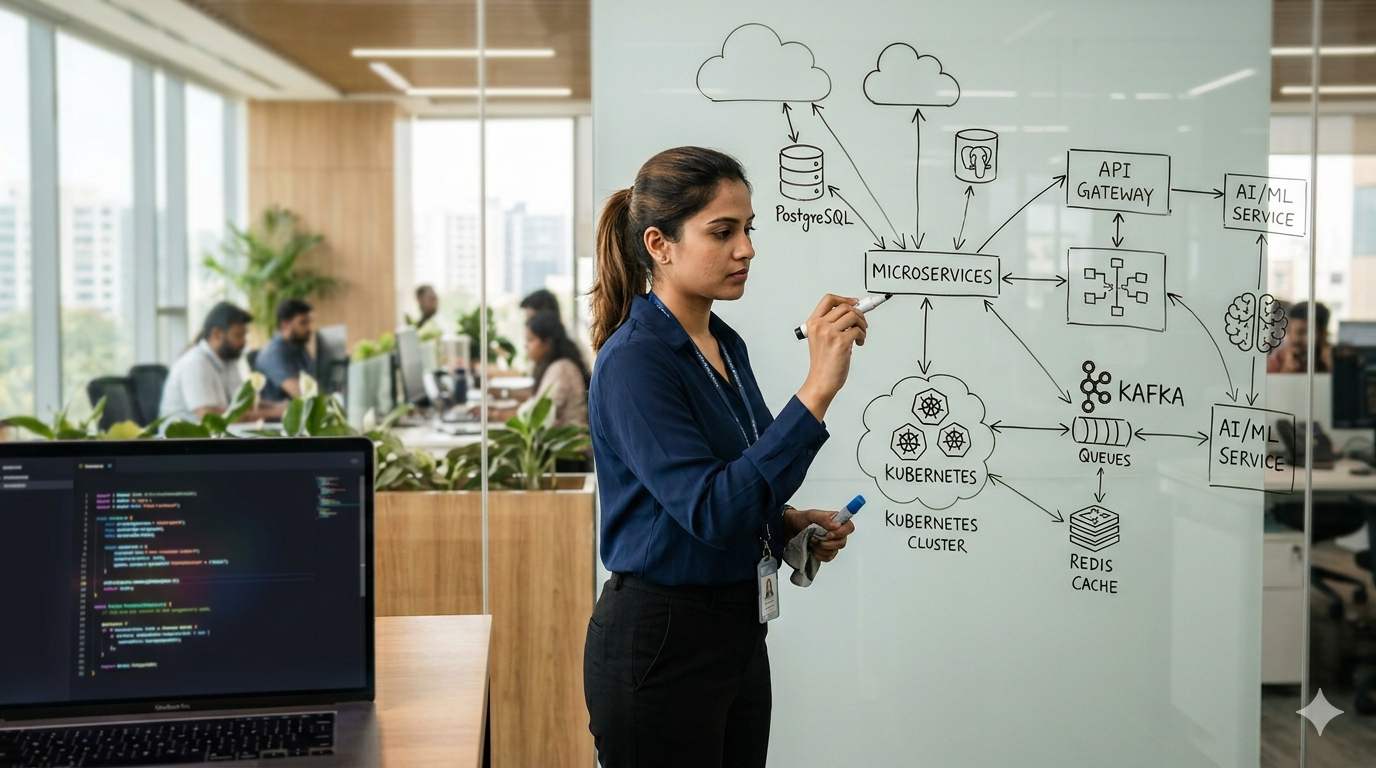
Fresher A opens a laptop. Pastes the question into ChatGPT. Gets a Redis + Kafka architecture in 40 seconds. Reads it back to the panel.
Fresher B puts the pen to the whiteboard. Asks a clarifying question: “Are we prioritising delivery guarantees or latency?” Sketches a message queue with idempotency keys. Explains why at-least-once delivery with deduplication is safer than exactly-once for this use case. Discusses what happens when a consumer goes down mid-delivery.
Fresher B gets the offer. Fresher A gets the standard “we’ll be in touch” email.
This is not a hypothetical. This scenario plays out daily across Bengaluru, Hyderabad, Pune, and Chennai hiring rounds in 2026. The rules changed, and most college curricula have not caught up.
The India Numbers First
Before the global picture, here is what is happening specifically in the Indian IT market.
Campus hiring at Tier-1 IT services companies dropped sharply. According to the NASSCOM Strategic Review 2025, India’s IT sector added 60,000 net new employees in FY2025 — down from 290,000 in FY2022. That is a 79% collapse in net headcount additions in three years. The industry overall employs 5.4 million people, but the entry-level funnel has narrowed dramatically.
Naukri JobSpeak data confirms the shift in demand. The Naukri JobSpeak Index (April 2026) shows IT fresher job postings down 31% year-on-year, while postings for “system design,” “solution architecture,” and “AI/ML integration” roles are up 44% over the same period. The market is not shrinking — it is sorting.
Indian IT services companies are automating the work they used to hire freshers for. TCS’s internal AI platform, WisdomNext, and Infosys’s AI-first delivery model now handle significant portions of code generation, test case writing, and integration boilerplate — the exact tasks that formed the on-the-job training ground for new hires. The 18-month learning runway that a 2019 fresher had at a service company simply does not exist in the same form today.
Product companies and GCCs are hiring, but selectively. Global Capability Centres (GCCs) — now over 1,700 in India per NASSCOM — are actively hiring engineers, but with a changed brief. They want developers who can architect, not just implement. The GCC segment added 1.9 lakh employees in FY2025, but the majority of those roles require 2+ years of experience or demonstrated system design competency even at fresher level.
The Global Data That Explains Why
The India picture does not exist in isolation. Here is the global research that explains the structural shift.
82% of developers now use AI coding tools daily — not experimentally, but as a core part of their workflow. This is from the Stack Overflow Developer Survey 2025, which surveyed over 65,000 developers worldwide. (survey.stackoverflow.co/2025)
41% of all code written today is AI-generated or AI-assisted. The AI code generation market grew from $4.91 billion in 2024 to a projected $30.1 billion by 2032, with coding representing 55% of all enterprise AI spend according to Menlo Ventures’ State of AI in the Application Layer report. (menlovc.com/2024-the-state-of-generative-ai-in-the-enterprise)
AI code has a trust problem that creates a skills premium. GitClear’s Coding on Copilot analysis found that while developers complete 21% more tasks with AI assistance, pull request review time increased 91%. Only 30% of AI-suggested code gets accepted without modification. The reason: AI-generated code looks correct at a glance but contains subtle architectural missteps, edge case failures, and security vulnerabilities that require deep expertise to catch. (gitclear.com/coding_on_copilot_data_analysis_2024)
The employment data is stark for young developers. Research from Harvard Business School found that junior developer employment at companies adopting generative AI tools fell approximately 9–10% within six quarters of adoption. A separate analysis from the Stanford Digital Economy Lab found employment among software developers aged 22–25 fell nearly 20% between 2022 and 2025.
The economic logic for Indian IT is identical. One senior developer with AI tools can now prototype, maintain, and debug what previously required three junior developers. At Indian salary bands — a senior developer at ₹25–35 LPA versus three freshers at ₹4–6 LPA each — the cost equation still favours leaner teams when productivity multiplies.
What TCS, Infosys, Wipro, and Indian Startups Are Actually Testing Now
The interview format at Indian IT companies has shifted more in the past 24 months than in the previous decade. Here is what is happening at each tier.
Tier-1 IT Services (TCS, Infosys, Wipro, HCL)
The National Qualifier Test (TQT/NQT) and similar mass hiring assessments still test coding — but the bar has changed. Companies are adding a system design component to campus drives that did not exist in 2022. Infosys’s InfyTQ platform now includes architecture scenario questions at the qualifier stage. TCS Digital and Prime tracks (which pay ₹7–9 LPA versus the base ₹3.36 LPA) explicitly test database design, API design, and problem decomposition — not just DSA.
The differentiation is stark: TCS base hiring (high volume, lower pay) still takes coders. TCS Digital and Prime tracks are looking for thinkers. The same split exists at Infosys (Systems Engineer vs. Specialist Programmer) and Wipro (Elite vs. Turbo).
What this means practically: If you are targeting a ₹7 LPA+ offer at a service company, you need system design preparation. Targeting ₹3–4 LPA? You still need clean code, but DSA is sufficient for the screen.
Tier-2 IT Services and Captives (Mphasis, LTIMindtree, Cognizant, Capgemini India)
These companies are actively offloading routine implementation to AI-assisted workflows and hiring for integration, quality review, and client-facing technical roles. Cognizant’s 2025 fresher brief explicitly mentions “AI tool proficiency” and “code review capability” alongside core programming. LTIMindtree is testing candidates on their ability to review code for correctness, not just write it.
Product Companies and GCCs (Flipkart, Swiggy, PhonePe, Amazon India, Google India)
System design rounds have always existed here, but the bar has moved down the experience ladder. GCCs and funded product startups are now expecting freshers to demonstrate basic distributed systems understanding — not expert-level, but enough to have an informed conversation about trade-offs.
Swiggy and Zomato engineering interviews for FY2026 campus hires include a low-level design (LLD) round that was previously reserved for candidates with 2+ years. The expectation is not perfection — it is demonstrated thinking.
Early-Stage Startups
Startups under Series B are the most pragmatic. They want developers who can ship end-to-end with AI tools, understand when AI output is wrong, and communicate with product and design without a middleman. The “full-stack generalist who thinks like a product manager” profile is more in demand here than anywhere else in the Indian market.
India Salary Reality: What the Market Pays for Thinking vs. Typing
Here is the salary split as of FY2026 based on data from AmbitionBox (ambitionbox.com) and Glassdoor India, for Bengaluru and Hyderabad markets:
| Role Profile | Experience | Typical Range (LPA) | Key Differentiator |
|---|---|---|---|
| Implementation-level fresher (DSA + frameworks only) | 0–1 yr | ₹3.5–5.5 | Can code; cannot design |
| TCS Digital / Infosys SP fresher | 0–1 yr | ₹7–9 | Basic LLD, system thinking |
| Backend engineer at GCC (system design capable) | 1–3 yr | ₹12–20 | Architecture + trade-off articulation |
| Senior engineer / tech lead at product company | 4–7 yr | ₹25–45 | AI-augmented output + cross-functional leadership |
| Solution architect at service major | 6–10 yr | ₹30–55 | End-to-end system ownership |
The gap between a ₹4 LPA offer and a ₹8 LPA offer at the same company — for the same graduation year — is almost entirely explained by system design and communication skills, not coding ability.
The Skills Hierarchy That Actually Gets You Hired in 2026
If implementation is commoditised, the following skills determine your market value. They are ordered by how quickly they can be developed.
1. System Design and Architecture Judgment
This is the highest-leverage skill to develop and the hardest to fake. It means understanding why architectural decisions exist, not just what they are.
Real examples relevant to Indian IT interviews:
- Why does Zepto use an event-driven inventory system rather than synchronous database writes? (Latency and scale under flash sales)
- Why would a payment system like PhonePe use idempotency keys? (Preventing duplicate debits on network retry)
- Why does a B2B SaaS with 200 enterprise clients need multi-tenancy architecture instead of separate databases per client?
You do not need to have built these systems. You need to be able to reason about them. Resources to develop this: Designing Data-Intensive Applications by Martin Kleppmann (the most recommended single book in Indian senior engineer interviews), and the free Grokking the System Design Interview course on educative.io (approximately ₹2,500/year for Indian pricing).
2. AI Output Review and Correction
This is immediately employable and undervalued by most freshers. The ability to take AI-generated code and identify the three things wrong with it is more valuable than the ability to write the code yourself.
Develop this by: taking GitHub Copilot or Claude outputs for standard problems and systematically identifying security gaps (SQL injection, improper input validation), race conditions, and missing error handling. Build a personal checklist. This is a learnable, demonstrable skill.
3. Problem Decomposition Before Coding
The ability to ask the right clarifying question before writing a single line of code separates candidates at every level of the Indian IT interview process. Practise this: take any product feature (Swiggy’s real-time driver tracking, IRCTC’s seat booking) and list every edge case and constraint before you design anything.
4. Cross-Functional Communication in English
At service companies interacting with US/UK clients, and at GCCs reporting to global headquarters, the ability to explain a technical trade-off to a non-technical stakeholder is a direct salary driver. This is especially true for Indian engineers where English communication is evaluated explicitly alongside technical ability.
5. Domain Understanding in High-Compliance Sectors
Healthcare (Apollo, Manipal’s digital health arms), BFSI (HDFC, ICICI’s technology centres), and logistics (Delhivery, Blue Dart tech) are sectors where understanding the domain — HIPAA equivalent regulations, RBI payment guidelines, GST reconciliation logic — makes a developer exponentially more valuable than raw coding skill.
The Indian Fresher Survival Plan: What to Do Right Now
If you are in your final year of B.Tech / BCA / MCA:
Months 1–2: Build CS fundamentals from first principles. Not frameworks — operating systems, computer networks, database internals. GATE CS preparation material (available free from NPTEL, nptel.ac.in) is the most efficient way to cover this. You do not need to write GATE — you need the conceptual foundation it builds.
Months 3–4: Do one end-to-end project that you can deploy and explain completely. Not a tutorial clone. Build something with a real constraint: “a cab booking system that handles surge pricing” or “a food delivery tracker with estimated time logic.” Host it. Be able to explain every architectural decision.
Months 5–6: Practise 30 system design problems using Designing Data-Intensive Applications as your reference. Target: one problem per day. Platforms with good Indian community support: Naukri’s free system design resources, Scaler’s YouTube channel (free), and InterviewBit’s LLD module.
Ongoing: Practice reviewing AI-generated code for bugs. Use free ChatGPT or Claude to generate code for standard problems, then find what is wrong. Document what you find. This is your differentiated portfolio.
If you are a working developer at 1–3 years:
You are at the pivot point. The implementation work you are doing today will be partially automated within 24 months at your current employer. Move now:
- Volunteer for architecture discussions and design review meetings, even as an observer initially
- Take AWS Solutions Architect Associate (SAA-C03) or Google Cloud Professional Cloud Architect — these certifications force system design thinking and are directly recognised by Indian IT and GCC hiring managers. AWS SAA costs approximately ₹12,000–₹15,000 for exam + preparation; ROI at Indian salary bands is typically 1–2 LPA increment within 12 months of certification
- Build a public GitHub repository of system design write-ups, not just code
What Gets Commoditised, What Stays Valuable
To be clear about the 3-year horizon for Indian IT specifically:
Being automated away in Indian IT context:
- Manual test case writing (already largely automated at TCS, Infosys via AI QA tools)
- CRUD application boilerplate for standard enterprise modules
- Basic API integration between known systems
- First-draft code for well-specified requirements
Remaining high-value:
- System design and architecture for India-scale products (100M+ user systems look different from US equivalents due to 2G/3G fallback requirements, regional language handling, UPI-specific payment flows)
- Security architecture, especially for RBI-regulated and SEBI-regulated systems
- Performance optimisation for India’s cost-constrained infrastructure context
- Technical communication with global stakeholders for GCC-based roles
Increasing in value:
- AI output quality review and prompt engineering for production codebases
- DevOps and infrastructure (Kubernetes, CI/CD pipelines) — AI writes code but doesn’t deploy it safely
- Domain expertise in BFSI, healthcare, and government IT (UMANG, DigiLocker integrations)
The Bottom Line
The Indian IT job market in 2026 is not collapsing — it is sorting. The developers who built careers on memorising syntax and replicating tutorial patterns are under pressure. The developers who can design systems, review AI output critically, explain trade-offs to stakeholders, and understand the business context of the code they write are in higher demand than at any point in the industry’s history.
The path from ₹4 LPA to ₹8 LPA is not more certifications in frameworks. It is demonstrable system thinking, deployed in an interview room before you write a single line of code.
Stop memorising APIs. Start understanding why systems are built the way they are. The era of the implementer is contracting. The era of the architect — even at fresher level — has already begun.
References
NASSCOM Strategic Review FY2025
nasscom.in/research — India IT/BPM sector workforce data, net headcount additions, GCC growth figures
Naukri JobSpeak Index — April 2026
naukri.com/jobspeak — Monthly IT hiring demand index by role and skill category
Stack Overflow Developer Survey 2025
survey.stackoverflow.co/2025 — AI tool adoption rates, developer trust data
Menlo Ventures — State of Generative AI in the Enterprise 2024
menlovc.com/2024-the-state-of-generative-ai-in-the-enterprise — AI application layer market sizing, coding category spend
GitClear — Coding on Copilot: 2024 Data Analysis
gitclear.com/coding_on_copilot_data_analysis_2024 — PR review time, AI code acceptance rates
Harvard Business School — Generative AI and the Workforce (2024)
hbs.edu/faculty/Pages/item.aspx?num=65576 — Junior developer employment impact data
LinkedIn India Emerging Jobs Report 2025
linkedin.com/pulse/linkedin-jobs-on-the-rise-india-2025 — India-specific role demand trends
AmbitionBox India Salary Data
ambitionbox.com — India fresher and mid-level IT salary benchmarks by company and role
Soundar S is a Career Skills Editor at SkillUpgradeHub covering IT career strategy for the Indian market. This article is updated bi-annually to reflect current Indian IT hiring trends.


